Welcome to the Lattice Boltzmann Research Group
The Lattice Boltzmann Research Group (LBRG) is an interdisciplinary research group that aims to take advantage of novel mathematical modeling strategies and numerical methods to enable large-scale simulations and optimal control of fluid flows for applications in process engineering. The LBRG aims at a better fundamental understanding of suspensions in general and for the improvement of mechanical processes and medical treatments. In particular the LBRG designs and uses models, algorithms, and open source simulation tools such as OpenLB, always taking advantage of modern high performance computers for the simulation of, for example:
- Particulate fluid flows
-
Thermal flows
-
Turbulent flows
-
Material transport and chemical reactive flows
-
Light transport
-
Fluid-structure interaction
-
Flows in porous media and complex geometries
The LBRG’s teaching and education concept is project- and research-oriented, offering for example basic programming courses, lectures on parallel computing, software tutorials, and advanced seminars on particular fluid flow simulations as well as optimal control theory.
Read more:
Latest News
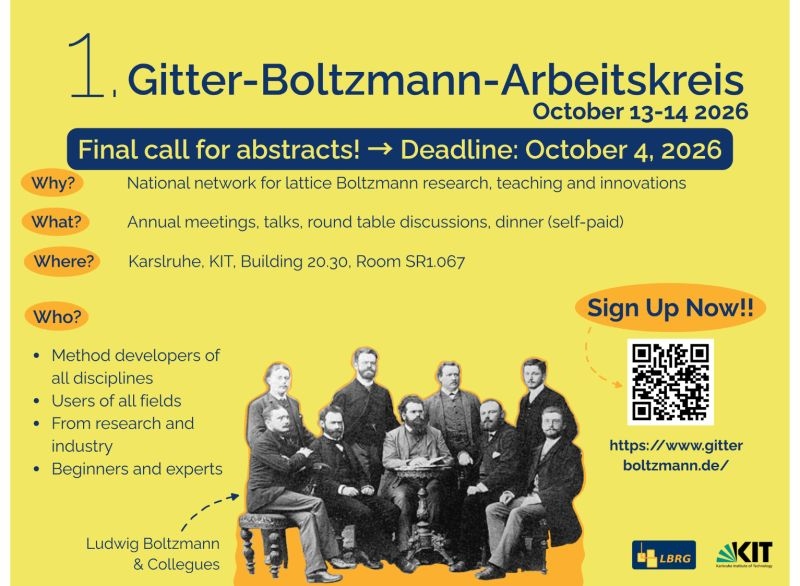
Only a few days left! The deadline for abstract submission for the first meeting of the Gitter-Boltzmann-Arbeitskreis is October 4, 2026.
The Lattice Boltzmann Research Group (LBRG) at KIT is hosting the 1. Gitter-Boltzmann-Arbeitskreis, a national network and forum for all lattice Boltzmann topics: research, teaching, innovation and projects.
📅 13–14 October 2026
📍 KIT Karlsruhe, Building 20.30, Room SR1.067
What to expect:
🔹 Talks on current LBM research and applications
🔹 Round table discussions
🔹 A joint dinner (self-paid) for networking and exchange
Who should join? Method developers from all disciplines, users from all fields, people from research and industry, and both beginners and experts.
Whether you want to present your latest results, share practical experience or simply connect with the German LBM community, we'd love to hear from you. Submit your abstract and register here.
Please share this with colleagues who might be interested. We look forward to seeing you in Karlsruhe!

The Lattice Boltzmann Research Group at KIT is very excited to share our latest paper: “Simulation of Particle Structure Rearrangement and Reaction in Wall-Flow Filters at High Flow Velocities with Lattice Boltzmann Methods". Ceramic wall-flow filters play a central role in the reduction of particulate matter emitted from combustion engines, which are used in passenger and commercial vehicles. During filtration, such a filter's particle load and the corresponding pressure drop continuously increase. Therefore, these filters are regularly regenerated by oxidation, burning off the organic parts of diesel soot and rearranging the inert (ash) part of the soot.
This video visualizes the ash fragment rearrangement process during regeneration of a wallflow filter. The inlet velocity of 60 m/s is chosen to resemble experiments by Ole Desens and Julia Thieringer.
To stabilize the simulation at usable resolutions, a Smagorinsky LBM-LES model is used.
Simulation and visualization by Christoph Gaul.
These results has been published in C. Gaul, O. Desens, P. Ernst, A. Nettekoven, A. Dittler, and M. J. Krause. “Simulation of Particle Structure Rearrangement and Reaction in Wall-Flow Filters at High Flow Velocities with Lattice Boltzmann Methods”. In: Fluids 11.8 (2026). issn: 2311-5521. doi: <10.3390/fluids11080194>. url: https://www.mdpi.com/2311-5521/11/8/194.
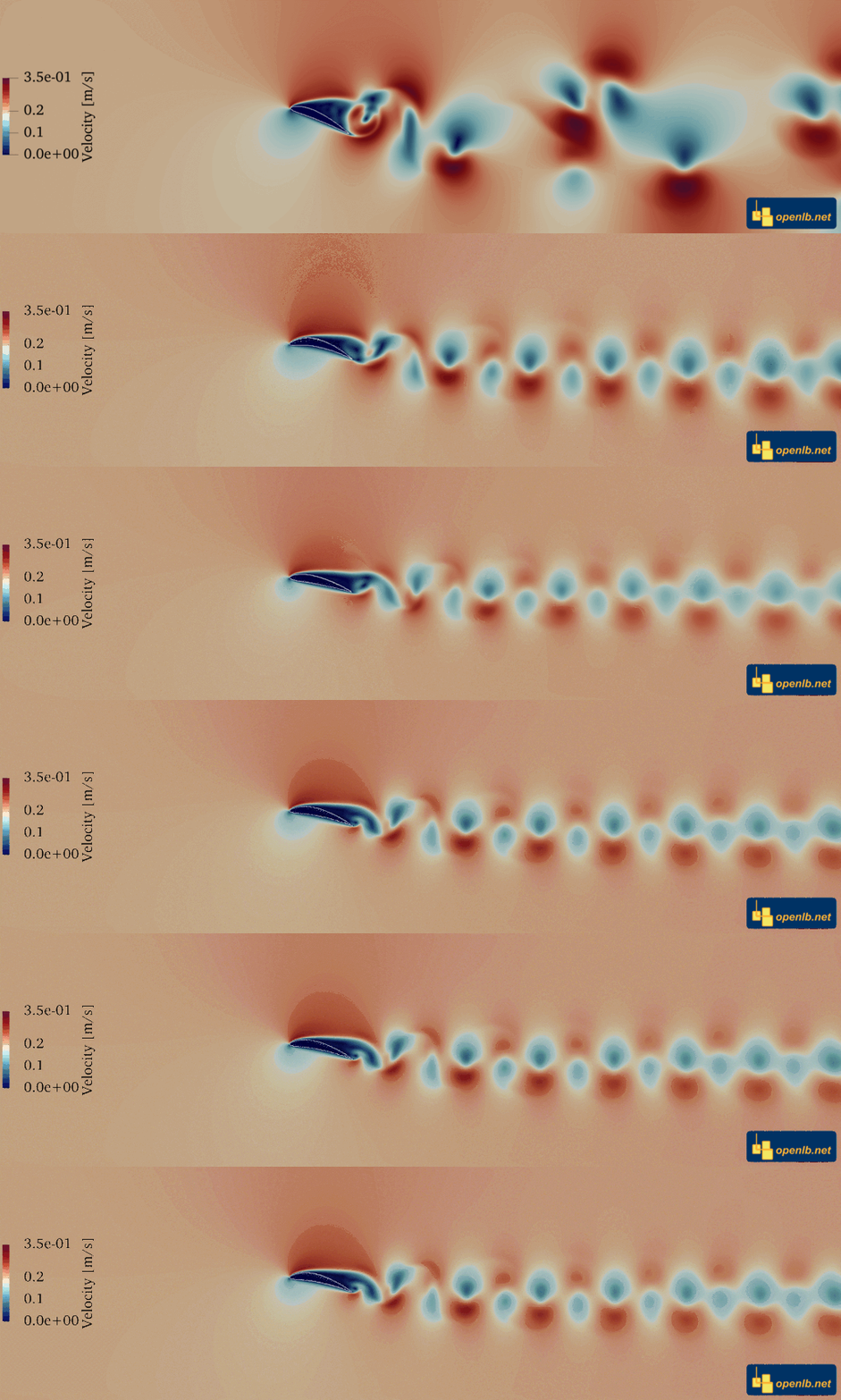
The Lattice Boltzmann Research Group (LBRG) at Karlsruher Institut für Technologie (KIT) congratulates Dominik Ebert on the successful completion of his Bachelor's thesis, focusing on the unsteady aerodynamic optimization of airfoils operating at a low Reynolds number (Re = 1000).
By controlling the maximum camber and the angle of attack, the gradient-based optimization setup in OpenLB successfully minimizes the objective function (-CL/CD), finding the optimal geometry and conditions to maximize the lift-to-drag ratio of a NACA 0012 Airfoil.
This thesis built upon previous work by Arsh Kumbhat.
Great work, Dominik, and we wish you the best in your future engineering career!